

Sustainable Development
Turning Passion into Purpose — Together, We Create the Future of Healthcare

Sustainable Development
Wistron has always adhered to an “altruistic” business philosophy, firmly believing that this principle is the foundation of sustainable corporate growth. We integrate sustainability into our daily operations and, through continuous practice, strive to improve and balance environmental, social, and governance aspects. By working closely with stakeholders, we aim to expand our positive impact.
Sustainable Supply Chain
To enhance the resilience of our supply chain, we must work closely with suppliers to create a sustainable, mutually beneficial, and thriving industry ecosystem. Suppliers are vital partners in this effort, and together we will continue to strengthen the sustainable supply chain framework, building a more resilient and impactful network. Wistron is committed to advancing sustainable supply chain practices. Since 2010, we have been a member of the Responsible Business Alliance (RBA), fully supporting its vision and objectives. We ensure that labor conditions within the supply chain are safe and respectful, and that all operational activities comply with environmental standards and uphold business ethics.
Responsible Minerals Management
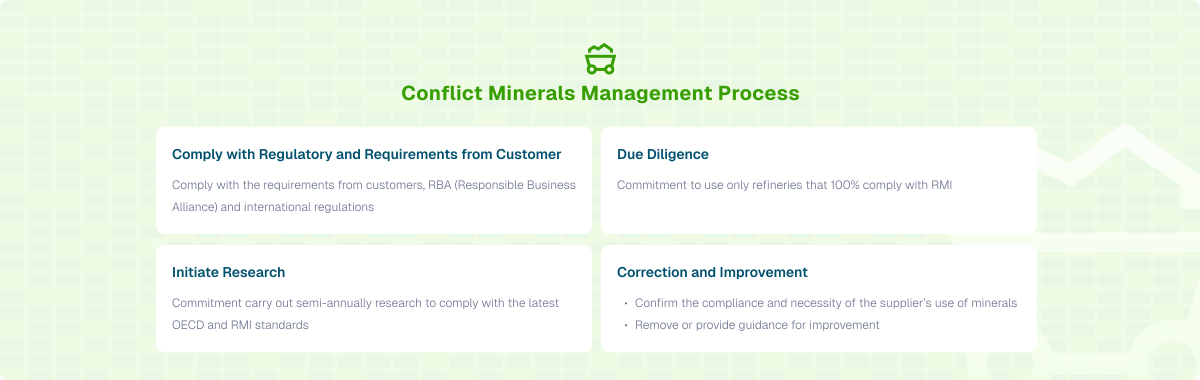
To achieve responsible and sustainable sourcing, Wistron has established a Conflict Minerals Policy and a responsible mineral procurement management process. We commit to sourcing minerals in compliance with the OECD Due Diligence Guidance for Responsible Supply Chains of Minerals from Conflict-Affected and High-Risk Areas or equivalent recognized frameworks. We conduct due diligence on suppliers to identify smelters and refiners verified as having systems that meet current global standards for responsible mineral sourcing, and we prohibit minerals originating from conflict-affected and high-risk areas. Wistron follows the Responsible Minerals Initiative (RMI) guidelines and has developed a Conflict Minerals Management Procedure to avoid inadvertently sourcing metals from conflict minerals. We require suppliers to establish policies ensuring reasonable traceability of gold (Au), tantalum (Ta), tungsten (W), tin (Sn), cobalt (Co), and mica in their products, and to conduct due diligence to confirm that sources comply with OECD requirements or exclude minerals from conflict-affected and high-risk areas as defined by recognized organizations. Each year, Wistron reassesses the list of smelters and refiners used in our products based on the Conformant Smelters List published on the RBA official website. We conduct conflict minerals investigations through Wistron’s SQP supplier questionnaire platform and audits for systematic management. Additionally, we use RMI’s Conflict Minerals Reporting Template (CMRT) and Extended Minerals Reporting Template (EMRT) to require suppliers to disclose mineral sources and sign a declaration of non-use of conflict minerals, ensuring compliance with customer and regulatory requirements. In 2024, 1,326 suppliers signed the declaration, achieving a 100% compliance rate. As part of our conflict minerals management process, we confirm with suppliers the necessity of using conflict minerals. If usage is deemed unnecessary, suppliers must cease procurement and usage, select new mineral sources, and provide valid evidence that the new sources meet RBA requirements for conflict-free minerals. If usage is necessary, suppliers are required to submit removal plans or improvement measures.

Social Impact
Through technological innovation, we develop advanced AI and machine learning capabilities to accelerate the transformation of smart healthcare services.

Our Actions
• Industry Collaboration: Strengthening technology applications • Academic Partnerships: Enhancing development momentum • Technology Validation: Improving patent quality

The Problem We Aim to Solve
AI technology gained significant attention in 2023; however, due to high entry barriers, practical application units often face operational constraints that make early-stage resource investment challenging. With years of experience in smart healthcare, Wistron integrates machine learning to accelerate the adoption of intelligent medical solutions across various settings.

Our Role
Through strategic alliances and collaborative projects with industry, government, and academia, Wistron strengthens partnerships to bring new technologies into real-world applications. Additionally, we leverage user feedback to optimize product development, achieving maximum effectiveness and addressing user pain points through technological innovation.
Advanced Technology Development
Develop cutting-edge AI and machine learning technologies and tools for application in smart healthcare products and services.
Wistron has established a deep academic collaboration with MIT CSAIL, working alongside distinguished professors to advance AI-based medical image interpretation and digital technology applications. Notably, we have achieved significant breakthroughs in Fully Homomorphic Encryption (FHE) technology, enabling the perfect integration of AI computation and data security. Through innovative human-interactive physiological sensing technology, we are creating new application scenarios for health and medical care. We also host in-person exchange meetings that bring together industry and academic leaders, including CSAIL professors, company executives, and team members—35 participants in total—laying a solid foundation for future development.
Medical Technology
AI Contactless Care Series Product
The AI Contactless Care Series product represents a major breakthrough in healthcare technology. Through non-contact intelligent monitoring, it enables round-the-clock collection of vital physiological data. Leveraging advanced remote wireless technology and AI algorithms, the system accurately tracks key indicators such as respiration, heart rate, and body temperature, providing real-time alerts to medical staff and optimizing care quality through big data analytics. As of 2024, the solution has been deployed in 73 facilities, including neonatal care units, long-term care centers, and hospital wards specializing in thoracic medicine, rehabilitation, cardiology, and isolation. It has safeguarded the health of over 21,000 patients and earned the 2024 National Health Research Institute’s Excellence Award for Promoting Elderly Care.
Integrating Smart Medical Devices and Technologies to Advance Domestic Industry
Wistron Medical Technology participates in the development of a 5G AI Pathology Service Platform, addressing critical gaps in digital pathology and smart healthcare. This initiative integrates diverse smart medical devices and technologies to enhance upstream and downstream industry capabilities in Taiwan. Centered on the Kaohsiung Asia New Bay Area Project, the plan focuses on developing a 5G AI pathology service platform and cross-hospital federated training services. Collaborating with three major medical centers in Kaohsiung—Kaohsiung Veterans General Hospital, Kaohsiung Medical University Hospital, and E-Da Hospital—the project aims to promote international digital pathology services, expand smart healthcare to overseas markets and New Southbound countries, and position Taiwan as a leader in the smart pathology industry chain.